Monday, April 4, 2016

We Will Be Attending

In 2013, the Audiofeed Festival began, as an attempt to keep the core “family” of the Cornerstone Festivals together, after that festival ended after its 2012 event.

We have attended two of the first three Audiofeeds, and it has begun to develop a culture and history of its own. And as it grows, the quantity and quality of the musical acts continue to improve.

More information about Audiofeed can be found at their website.

Saturday, March 19, 2016

Podcast #004 - The Jedi Path

"You've Taken Your First Step Into a Larger World."


In this all-new, super-special fourth podcast episode, Emily & Alan talk about some of the religious and theological topics that arise from Star Wars. We talk about the Force, dualism, and warrior monks.

We also talk about our thoughts on "The Force Awakens," and cover lots of terrific feedback from our terrific feedbackers.

Click on the player below to listen to the episode:


You may also subscribe to the podcast through iTunes or the RSS Feed.

Link: Anderson Cale's music 

We would love to hear from you about this issue, the podcast episode, or the podcast in general. Send e-mail feedback to dorknesstolight@gmail.com 

You can follow Alan on twitter @ProfessorAlan or the podcast @DorknessToLight

Monday, March 7, 2016

Church Teachings ... via LEGO!

Father Roderick Vonhogen is a parish priest in the Netherlands. He is also one of the Catholic Church's leading voices in the use of new media, social media, and podcasting. He has even written a book about his experiences as a Catholic geek priest. You may remember him as the fellow with the awesome reaction video to the first "The Force Awakens" trailer:


One of his recent efforts is to make 60-second stop-action Lego videos to explain church teachings. Such as Pentecost:


And the Pope's declaration of "A Year of Mercy:"


What the world needs now is ... definitely ... more teachings delivered via LEGO!

Tuesday, February 23, 2016

Dead Theologians Society: St. Polycarp

If you study the early church, I mean the really early church, you quickly run into St. Polycarp. A disciple of the Apostle John, Polycarp lived from 69 to 155, becoming the bishop of Smyrna – some accounts indicate that John nay have ordained him to that position.

Polycarp is an important link in the theological and leadership chain of the church, mentoring Irenaeus, who heard him speak in his youth, as well as Tertullian. Serving in an area led by a government opposed to the new religion, he led his flock for decades. At the age of 86, Polycarp was led into a stadium in Smyrna to be burned alive. After that attempt failed, he was finally killed by a dagger.

Only one of the many letters written by Polycarp is still extant, one written to the Church of Philippi. One passage instructs believers on the proper attitude to maintain. “Stand fast, therefore, in this conduct and follow the example of the Lord, ‘firm and unchangeable in faith, lovers of the brotherhood, loving each other, united in truth,’ helping each other with the mildness of the Lord, despising no man.”

Along with Clement and Ignatius, Polycarp is considered on the Apostolic Fathers of the 2nd Century church.

Tuesday, February 9, 2016

Nephilim and Angels in Danielle Trussoni’s Angelology

Few obscure Bible passages have generated more theological and creative speculation than Genesis 6:4.
“The Nephilim were on the earth in those days, and also afterward, when the sons of God came in to the daughters of man and they bore children to them. These were the mighty men who were of old, the men of renown.” – English Standard Version
In her novel Angelology, Danielle Trussoni has an interesting take on the topic. The idea is that the great old families of Europe, the powers behind the thrones (and in some cases on the thrones) are the descendants of Nephilim. Sister Evangeline and her sisters, part of the Society of Angelologists, end up on the front lines of the spiritual battle.
The Angelologists believe that Nephilim are behind history’s greatest acts of evil – war, genocide, famine and slavery. The idea is that their wealth and influence have allowed the Nephilim to develop institutions and systems that suppress ordinary people.But as the years have passed, the Nephilim's bloodlines have becoe weakened, and their influence may be waning.
I really enjoyed Trussoni's take on the topic, as different as it was from other versions of Nephilim stories I have run across before.
There is a second novel in the series, and I expect to read it soon.
general-interest review of the novel appears at Alan’s Eyes & Ears.

Monday, February 1, 2016

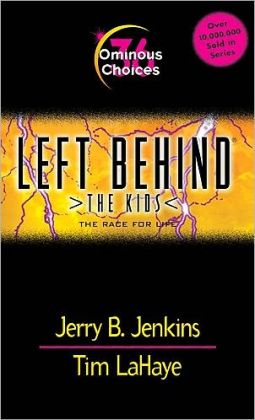
Surprised by Left Behind: The Kids #36


At some other point in time, I’ll discuss WHY I’m reading the 40-book Left Behind: The Kids series. But for now, let me discuss a number of surprisingly good moments I found in Book 36, “Ominous Choices.”
I understand that the phrase “surprisingly good” is a backhanded compliment. Let me say that I am not criticizing the technical skill of Chris Fabry, the actual writer of the young adult series. He did a very good job weaving recognizable events from the main Left Behind series into early books in his series, keeping the timelines of the two series consistent.
But what I’m referring to here as “surprisingly good” are events that I was genuinely surprised to find portrayed in a YA book published more than a decade ago by an evangelical publishing house. For example, there is a childbirth scene that is not graphic by any means, but is more specific and realistic than I was expecting to find.
But the biggest surprise was the resolution of the situation that one of our lead characters for the entire series found himself in. Lionel became pinned under a large boulder, and after many prayers for his rescue, he went “127 hours” on himself and cut off his own arm. In a series where angels regularly perform miracles, and many character were praying for Lionel’s rescue, this resolution is surprising.
During Lionel’s ordeal, Judd searched for aid for his friend, and ran into a kindly doctor who helped him, despite having pledged his allegiance to the Anti-Christ. Judd shared the gospel with the man, and he was moved by Judd, but he did not respond by accepting Christ. In fact, he responded by killing himself.
These situations each show a theological subtlety that is rarely if ever displayed in the prior 35 books in the series. The specific acts portrayed also depart from the highly sanitized books that preceded this one.
I wonder if with five books left in the series, the editors decided to “let things go.” Or perhaps Fabry just decided to push the borders a bit, again knowing that only five books were left in the series. However and whyever this change happened, I hope it continues as the series moves towards its conclusion.